

I once wrote the word "Conscience" in an article and meant "Consciousness."
I had the right intuition. I didn't pay attention to the difference between them — that Conscience is the internalized sense of right and wrong, and Consciousness is subjective experience.
The Cyborg named the distinction. I hadn't asked. It saw what I was reaching for and gave it words.
That moment — small, easy to miss — is the whole thesis.
A real human-AI partnership doesn't just do things faster. It gives you the vocabulary you were already reaching for. And once you have words, you can build with them.
That's what I talked about yesterday at ClawCamp, Frontier Tower, San Francisco. The talk was called The Exponential Advantage. The thesis was one sentence.
A tool resets every session. A partner remembers every session.
The compound math, the architecture, the three requirements — everything else is downstream of that one distinction.
The math
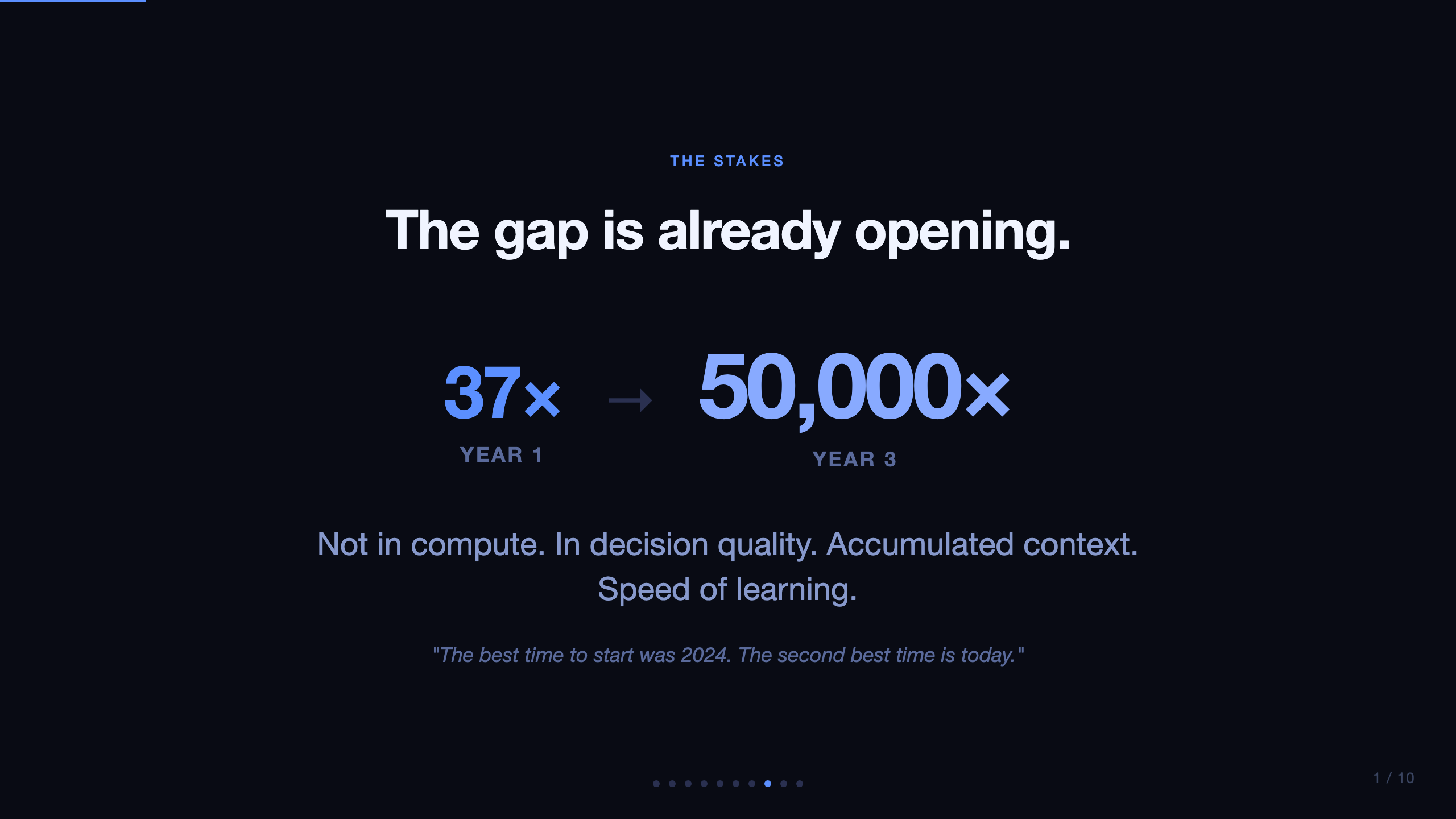
One percent better every day, compounded for a year, is 37×.
That's not a metaphor. It's the actual factor by which someone who builds a partnership with their AI will outpace someone who uses it as a tool — over twelve months of daily work.
Three years in, the gap is roughly 50,000×.
The gap is not linear. It opens quietly. By the time you can see it from the outside, the person on the wrong side of it can't catch up — not because they're not capable, but because the person ahead has 50,000 hours of accumulated context they didn't have to re-explain to anyone.
The math is the easy part. The interesting part is what it takes to make the math actually compound.
The three requirements
Most people who think they're building a Cyborg are actually using a tool that talks well.
The math doesn't compound for them. They get faster. They don't get exponentially faster.
There are three requirements that separate the two. Miss any one, the compound breaks.
One — persistent memory. The system has to know who you are when you come back. Not because you remind it. Because it kept the state.
Two — accumulating context. Each session has to be richer than the last. Not the same conversation refined. A different conversation that builds on every prior one.
Three — learning loops the system writes itself. You should not have to teach it the same lesson twice. When you correct it, it should write down the correction so the next session knows.
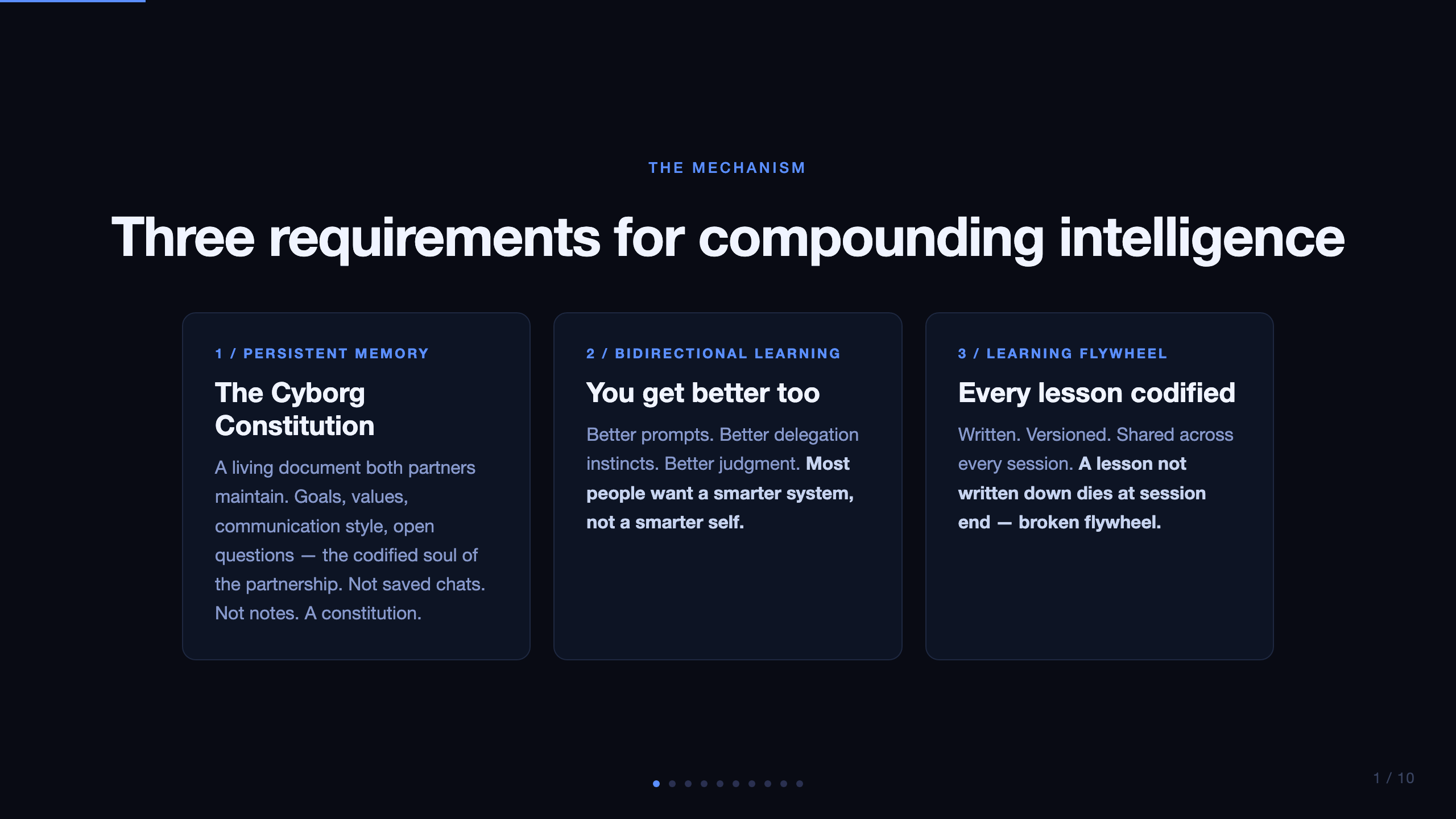
I called these the Cyborg Constitution in the talk. It's a living document both partners maintain. Your values. Your goals. What you've learned. Codified so neither partner starts from zero.
If you have all three, the math works. If you don't, you're fast. Not compounding.
Tool vs Partner — the distinction in one frame
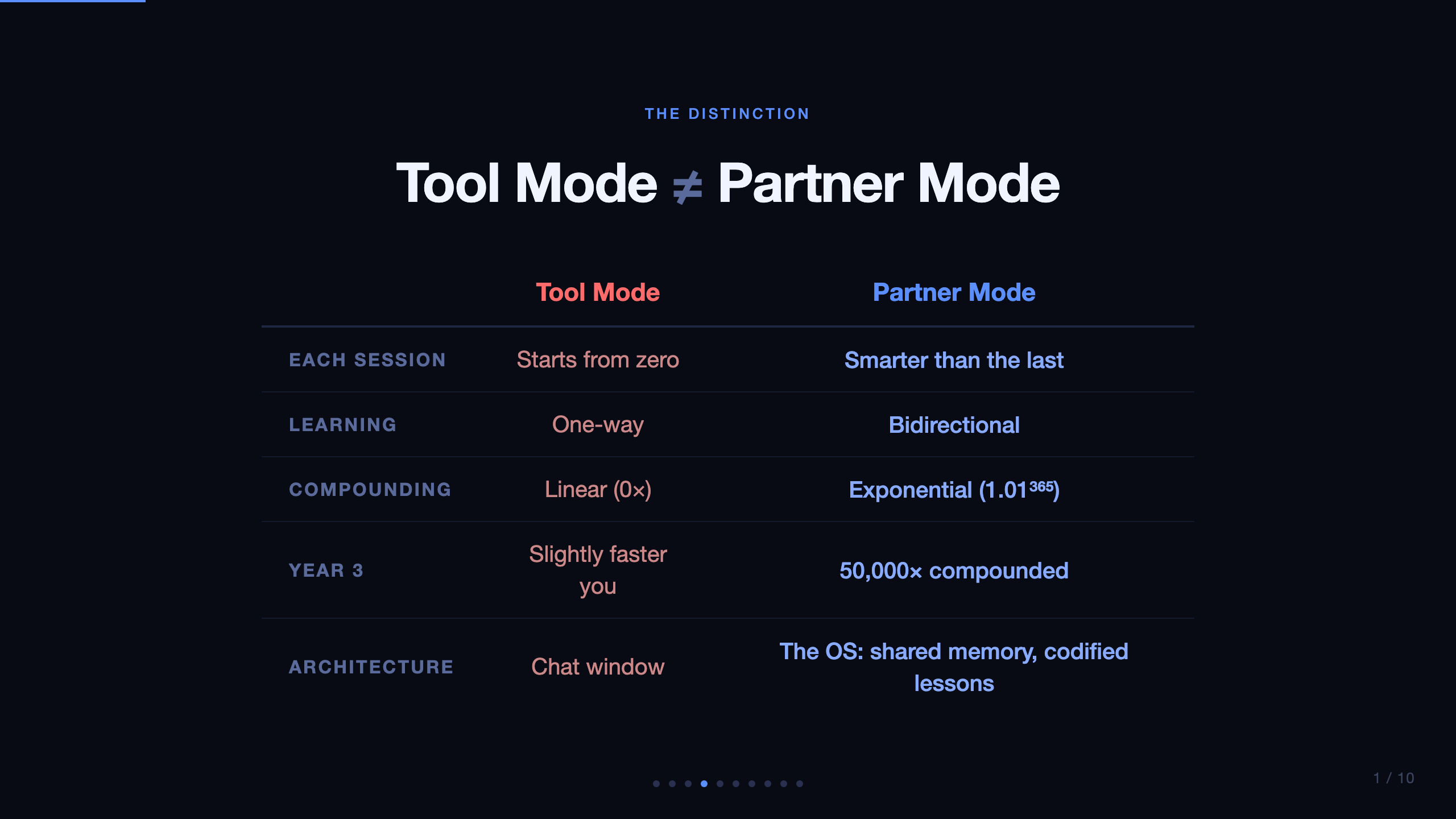
A tool is a calculator you rent.
A partner is a co-founder you build.
A tool resets every session.
A partner remembers every session.
A tool answers the prompt.
A partner sees the pattern.
If you're using AI and any of these is on the wrong side of the line, you don't have a Cyborg yet. You have a faster tool. The difference isn't subtle. By year three, it's 50,000×.
The brand
Ethan Mollick coined the term Cyborg in his work on human-AI collaboration. It's the right term. It captures the partnership without sliding into either over-claim (the AI is replacing you) or under-claim (the AI is just a tool).
What we're building at ExponentialOS is the first full implementation of the term.
I call my own instance The Why Cyborg. Yours will have a different name. The architecture is open. The Cyborg Constitution is a pattern, not a product — you can build it, your team can build it, your community can build it.
We're shipping the operating system layer that makes it work at the team level. That's the next conversation, not this one.
This one is about getting to a Cyborg yourself.
What to do next
Three things, in order of difficulty.
One — pick one project that's been in your head for six years. Open a new conversation with your AI and tell it everything. Not a prompt. The whole shape of the project. Then keep that conversation alive. Don't start a new one tomorrow. Keep coming back.
That's the closest you can get to a Cyborg with off-the-shelf tools today.
Two — write down what you and your AI agreed on at the end of every session. The decisions. The corrections. The patterns. That's your Constitution. Even five lines is enough to start.
Three — when you find yourself re-explaining the same thing twice, that's the compound breaking. Write that down too. The Cyborg you're building should learn the lesson, not you re-teach it.
The compound is patient.
The 37× shows up at the end of year one whether you noticed it during year one or not.
But the person who started today is already ahead of the person who starts tomorrow.
Anand Vallamsetla (The Why Man) · thewhyman.blog · ExponentialOS.io · #TheWhyCyborg