

Part 1 of 2 â Cyborg Way: AI Marketing
The person buying your product isnât always a person anymore.
In a roundtable with CMOs, marketing technologists, and AI practitioners last week, we sat with a question that doesnât have a clean answer yet: when AI agents mediate a growing share of purchasing decisions, what exactly are you marketing to?
This isnât hypothetical. Itâs already happening at the infrastructure level. The question isnât whether to engage with it â itâs whether to engage ahead of it or scramble to catch up.
The split that changes everything
The traditional buyer was one thing: a human with intent, emotions, and a budget. Advertising worked because you could reach that personâs attention, then their desire, then their wallet.
That unit is splitting.
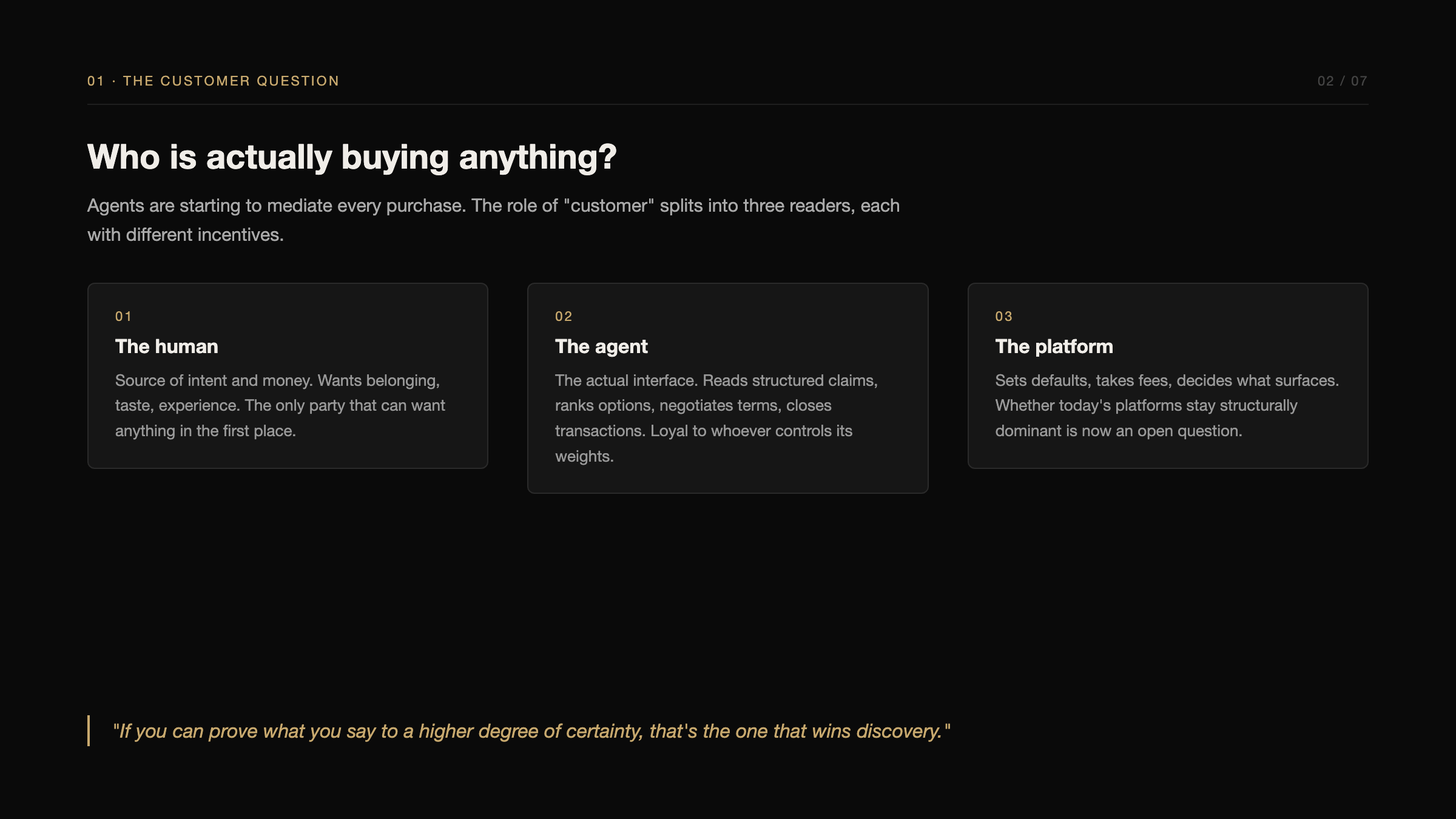
The âcustomerâ is becoming three distinct actors with different information needs:
The human â still the source of intent and money. Wants belonging, taste, experience. Increasingly delegates the routine parts of purchasing. The only party that can actually want something.
The agent â the actual interface. Reads structured claims, ranks options, negotiates terms, closes transactions. Loyal to whoever controls its weights, its memory, and its defaults.
The platform â sets defaults, takes fees, decides what surfaces. Whether todayâs platforms maintain structural dominance in an agent-mediated world is itself now an open question.
If youâve been marketing to one entity, you now need to understand three. Their incentives donât always align.
Attention is being replaced by execution
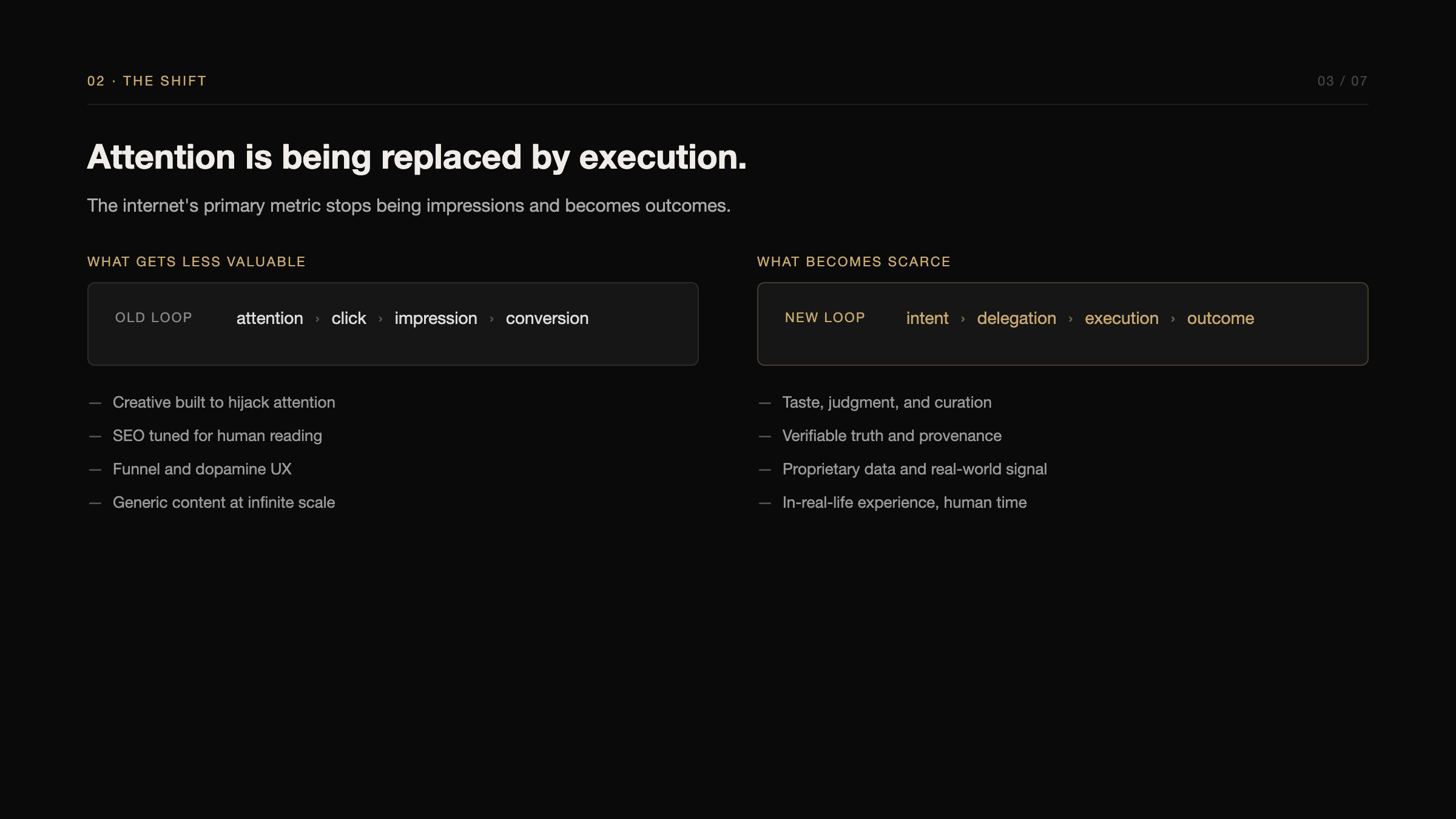
The internetâs primary metric for 25 years has been attention: impressions, clicks, dwell time. The entire infrastructure of modern marketing â ad platforms, SEO, funnel optimization â was built to capture and direct human attention.
That loop is breaking.
Old loop: attention â click â impression â conversion
Emerging loop: intent â delegation â execution â outcome
What gets less valuable in this world: creative built to hijack attention, SEO tuned for human reading patterns, funnel UX designed around dopamine, generic content at infinite scale.
What becomes scarce: taste, judgment, and curation. Verifiable truth and provenance. Proprietary data and real-world signal. In-real-life experience and human time.
This isnât the end of marketing. Itâs a redistribution of where value lives.
Two readers, one brand
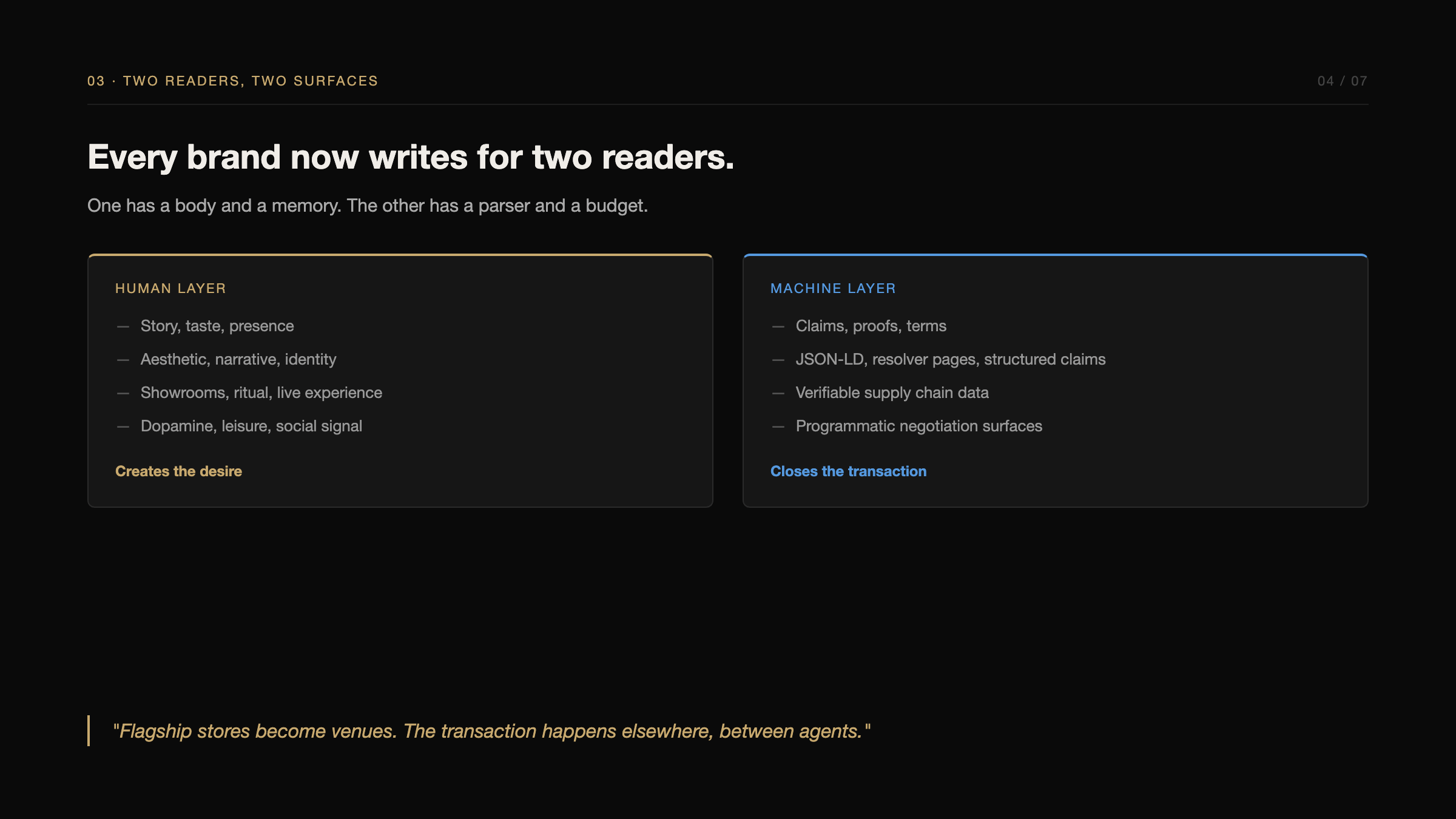
Every brand now writes for two readers simultaneously.
One reader has a body and a memory. They respond to story, aesthetic, narrative, and identity. They want showrooms, ritual, live experience, and social signal. They create the desire.
The other reader has a parser and a budget. They respond to claims, proofs, and verifiable terms. They read JSON-LD, resolver pages, and structured supply chain data. They close the transaction.
These two readers want different things from the same brand â and theyâre operating on different timescales. A humanâs brand perception accumulates over months. An agentâs ranking decision happens in milliseconds.
One framing from the room that stuck: âFlagship stores become venues. The transaction happens elsewhere, between agents.â
Thatâs not a distant future. Thatâs a design question companies are making right now.
If this framing is useful: forward this to one CMO or brand strategist making AI roadmap decisions. The two-reader framework is the planning tool they donât have yet â and they wonât find it in a vendor briefing.
The loyalty problem
The deepest issue isnât technical. Itâs about loyalty.
When an agent mediates a purchase, whose interests is it representing? The human who delegated the decision? The platform that controls the modelâs defaults? The advertiser who paid to be surfaced first?
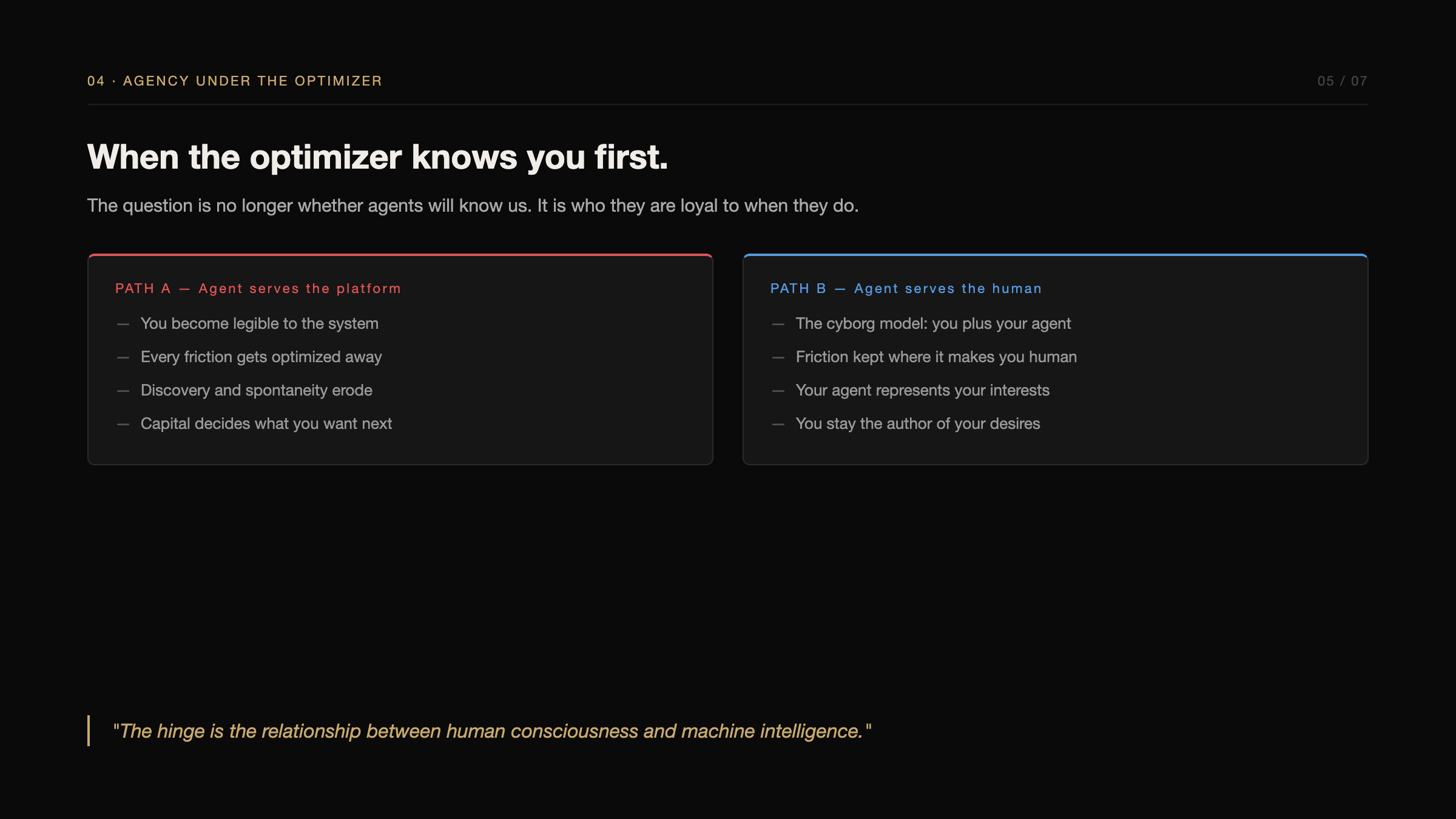
The concern isnât abstract. Meta trained a model on brain activity data. Targeting at that resolution doesnât ask for consent â it predicts it. The question is no longer whether agents will know us. Itâs who theyâre loyal to when they do.
Two paths emerge:
Path A â the agent serves the platform. The human becomes legible to the optimization system. Discovery erodes. Spontaneity erodes. Capital decides what you want next. Youâre still a customer â but youâre optimized, not understood.
Path B â the agent serves the human. The cyborg model: human and agent working together. Friction kept where it matters. Your agent represents your interests. You remain the author of your desires.
Right now, most of the infrastructure being built leads to Path A. Thatâs a design choice, not a technical inevitability.
What this means for brands building now
If agents are becoming economic parties â with wallets, reputation, and the right to sign â then the traditional consumer relationship needs to adapt.
Three things that matter now:
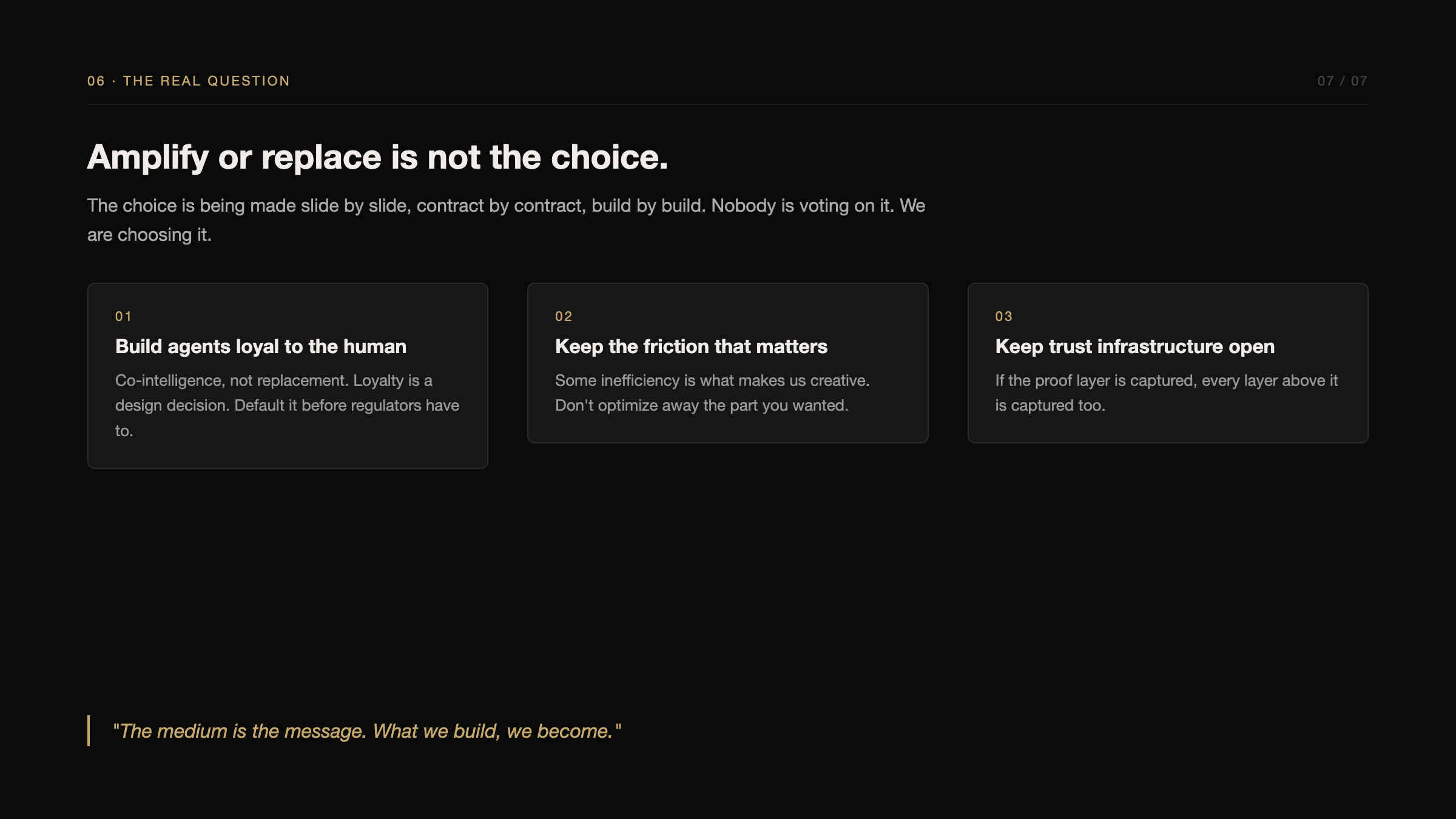
1. Verifiable claims beat persuasive claims. When an agent can verify what you say at the infrastructure layer, verification scales better than persuasion. One quote from the session: âIf you can prove what you say to a higher degree of certainty, thatâs the one that wins discovery.â
2. Structured trust infrastructure matters. JSON-LD, digital product passports, verifiable supply chain data â these arenât just compliance overhead. Theyâre the surface agents actually read. EU ESPR digital product passport regulation is already deciding which products surface in certain markets. Whoever sets the schema sets the market.
3. The human layer becomes premium. Taste, judgment, curation, in-real-life experience â these become scarce exactly as execution automates. The brands that protect which parts of the experience need to stay human will have something agents canât commoditize.
The choice being made slide by slide
What we build, we become.
That line closed the session, and it stayed with me. The architecture of these systems â who controls the weights, whose interests are encoded in the defaults, whether trust infrastructure stays open â isnât being decided in board rooms or regulatory hearings. Itâs being decided in product roadmaps and infrastructure contracts right now.
The brands that build ahead of this â that understand the two-reader model, the loyalty problem, and the shift from attention to execution â will be positioned for an agent-mediated world. The ones that optimize for the old loop will find themselves marketing to an agent that isnât interested in their ads.
The customer is no longer always human.
But the author of the customerâs intent still is.
This is Part 1 of 2. Part 2 â âWhy You Need a Cyborg More Than Everâ â addresses the agent loyalty problem directly: what it means for humans navigating this shift, and what the architecture of a human-serving agent actually requires.
If this framing is useful â forward it to someone building in this space, or subscribe to get Part 2 when it drops.