

AI SECURITY & TRUST #1 · Where identity is thin, and nothing shows it.
A companion to The Startup Moat Moved. That one showed AI collapsing what it takes to build a company. This one shows the same collapse pointed the other way: what it now takes to run an attack that used to need a crew.
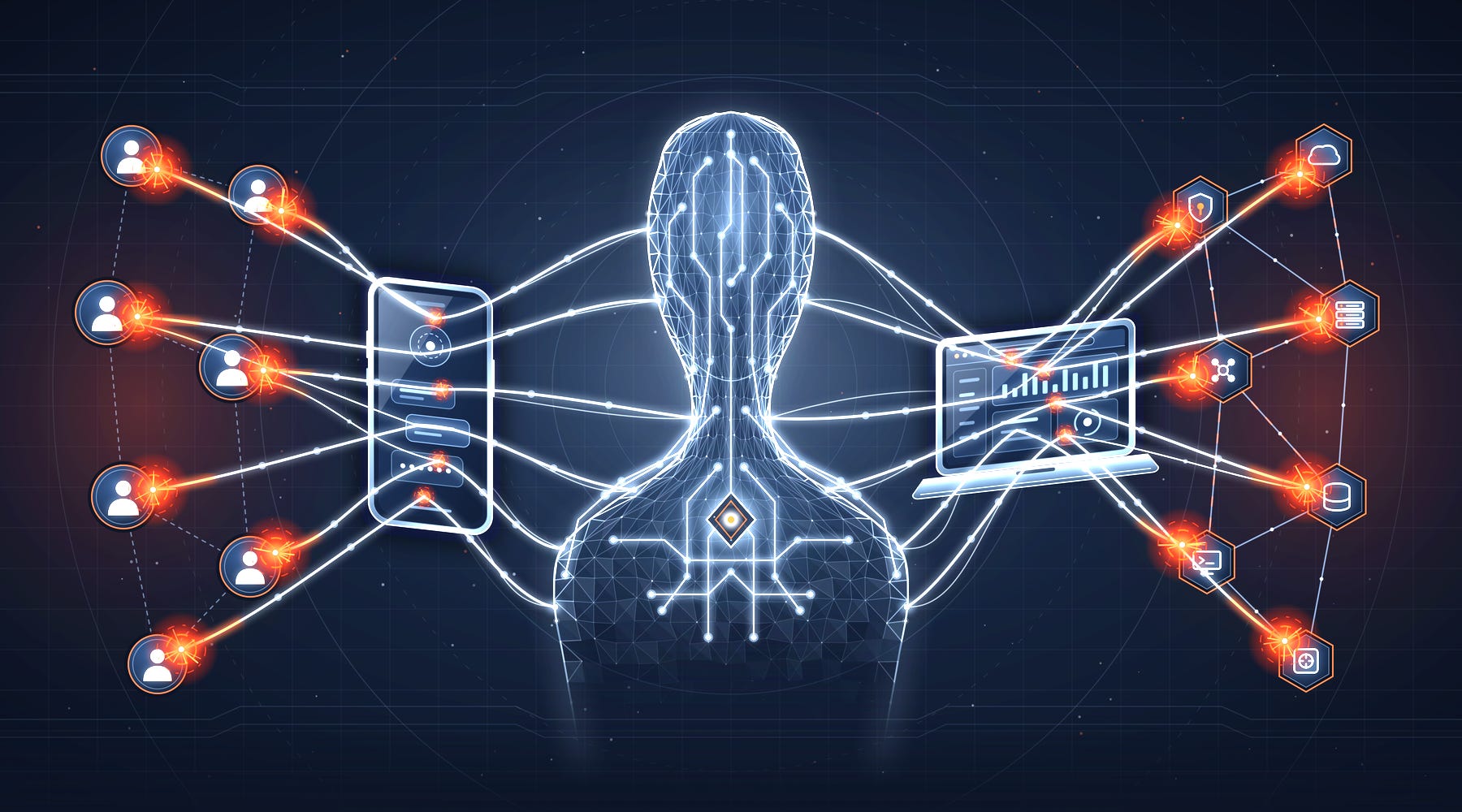
In the last three months, four different attacks came after me: email, video, voice, and text. Each one used a different channel. Each one used the same weakness.
First, an email arrived from a real @google.com address: “Your administrator has reset your Google Account password.” I don’t have an administrator. It’s my personal account. The email was genuine. Google’s own servers sent it, because the “administrator” was an attacker who had simply registered a free Google Workspace trial and named it something that looked official.

Second, a video call. Someone pitching himself as a project director for an AI platform wanted to show me what he was building. He asked me to clone a private repo and run it locally. When I pushed back, he needled me: “you don’t know how to run an npm install?”. Then walked me through it line by line. A second “app” asked me to connect a crypto wallet and grant permission to read outside my workspace. “Allow, allow, allow.” I’d been burned before by a malicious browser extension, so I said no. He went quiet and the call ended.

Third, a call from a 650 number showing “Google” as the caller. Someone impersonating Google security claimed my account had been flagged, then tried to get me to confirm my other emails and phone numbers. I hung up, gave wrong information on a second call, and blocked the number. They called back from a new one.

Fourth, a text in the same thread as a real Coinbase two-factor code, a spoofed message, worded almost identically to the real ones, urging action.
Four incidents. Three months. One mechanism underneath all of them: the attacker’s identity is always freshly minted, and nothing around you surfaces that as a warning. The Workspace trial was created minutes before it emailed me. The repo had no history. The 650 number was burned and replaced within days. The spoofed text came from a number Coinbase never uses. None of that newness was hidden. It just wasn’t shown to me at the moment I needed it.
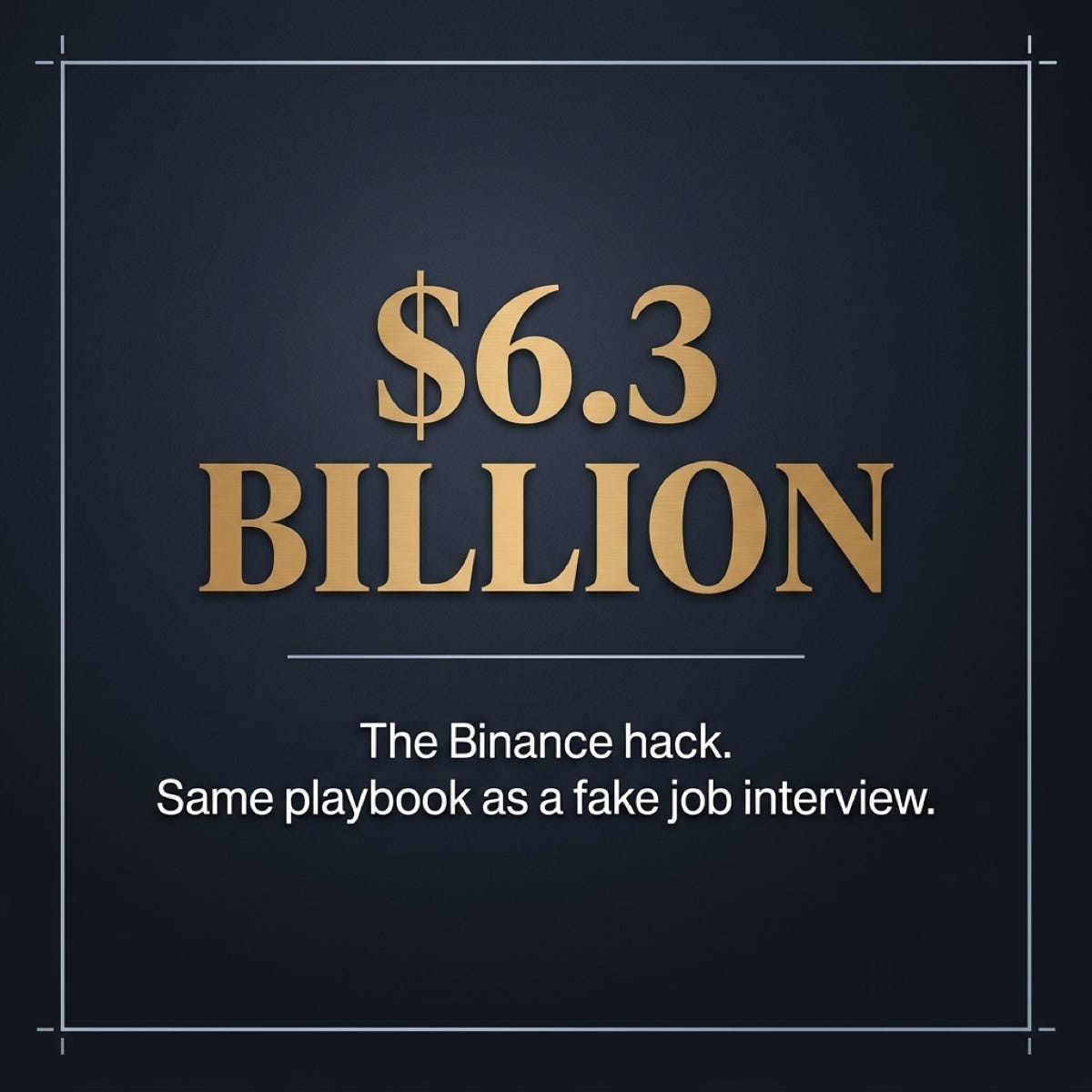
Here’s why this isn’t a personal story. The exact same mechanism, a fake interview, “clone and run this to prove yourself,” a crypto wallet connect, is the entry point behind the largest crypto theft in history: the $6.3 billion Binance hack on October 29, 2026, which the FBI and blockchain-intelligence firm TRM Labs attributed to North Korea’s “TraderTraitor” cluster, with the DOJ since moving to seize or restrain more than $1.2 billion of the proceeds. A related cluster, tracked separately as “Contagious Interview,” has been documented running fake recruiter and advisor pitches across LinkedIn, Discord, and video calls, pushing victims toward malicious repos, with over 1,700 malicious npm and PyPI packages tied to it since early 2025. I can’t tell you the call I was on was that specific campaign. I only have tactic-matching, not attribution, but the tactics are identical down to the detail: the fake urgency, the “prove you can run this,” the wallet connect. A separate DPRK-linked cluster, “WaterPlum,” used the same playbook to drain $10.7 million from 7,000 wallets. Chainalysis puts total crypto fraud losses at $17 billion in 2025 alone, with impersonation scams up 1,400% year over year.
Every one of those attacks was also enabled by AI in a specific way, not just a general one: AI-written phishing copy that doesn’t read like a scam anymore, a synthetic or spoofed voice good enough to hold a live call, caller-ID and texting tools that used to require a call center and now take one person an afternoon to set up. That’s the thesis, stated plainly: AI didn’t invent any of these four attack types. It collapsed the crew each one used to require down to one person.
What happened to me is the same mechanism, not necessarily the same actor, I have no attribution evidence either way, that just moved $6.3 billion. That should change how you read the rest of this.
Part 1. If you’re a user: what to watch for
Four tells, four actions. No architecture, just what to do starting now.
An unexpected “your administrator reset your password” email, on an account that has no administrator. Don’t click anything in it. Go directly to myaccount.google.com/security by typing it yourself, and report the email as phishing.
Anyone, recruiter, advisor, investor, “just want to show you something”, asking you to clone and run their code locally to prove interest, or to connect a crypto wallet to evaluate a product. Decline. A legitimate product almost always has a hosted demo or a login. Needing you to execute their code on your machine, or sign a wallet transaction, to “see what we built” is itself a warning sign worth treating as one.
A call from a recognizable brand name, demanding you confirm personal information or react to an urgent security flag. Hang up. Legitimate companies very rarely call you cold about account security. Google’s own guidance, for one, says they won’t. Look the number up yourself and call back if you’re unsure, never the number they gave you.
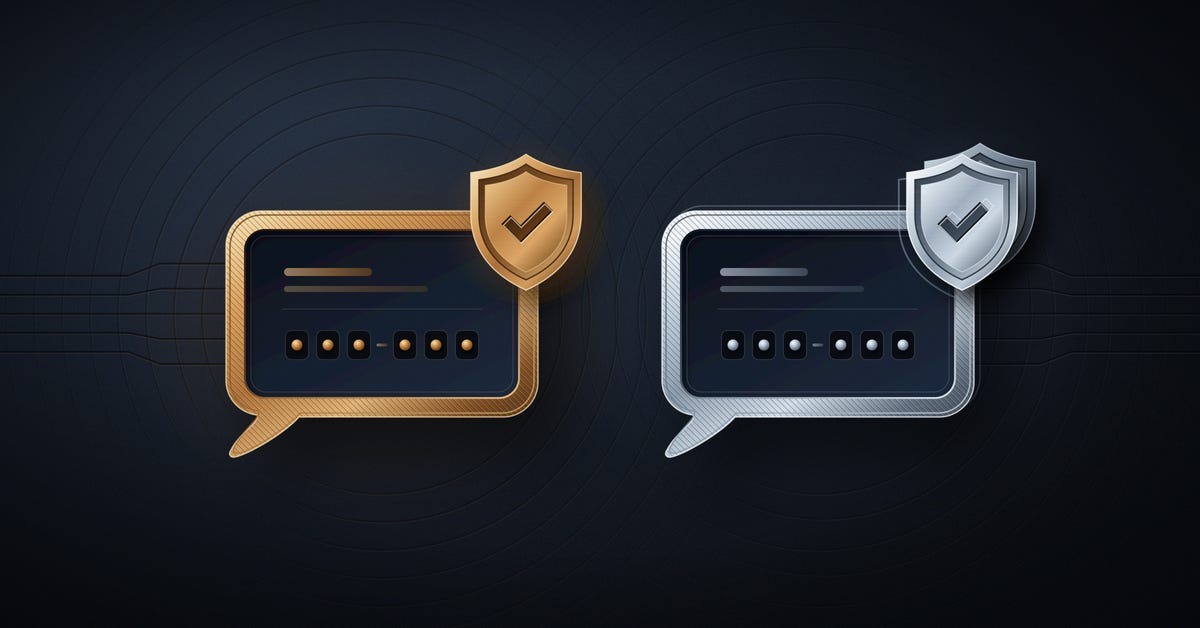
A text sitting in the same thread as your real two-factor codes, asking you to act or call a number. Never read a code aloud to anyone, for any reason. If your platform offers a personal security phrase, set one. A copycat text can match the wording, it can’t match a phrase only you and the real company know.
Part 2. If you’re a builder: what you could ship fast
Here’s the part that matters most to me: none of these four fixes require inventing anything. They require surfacing data a company already holds, with no coordination with anyone else. I’m not the one who can tell you exactly how long each takes inside a real engineering org, only that the data already exists, which is the hard part most new security work has to solve from zero.
Google already knows a Workspace org’s creation date, and whether you were ever a verified member before being added as a “recovery” contact. Ship a banner inside the email itself, not a link, the banner, on any admin-triggered account action from an org under some age threshold: “This organization was created [date]. You have never been a verified member.” That’s a UI and copy decision on data already in hand.
GitHub already has repo age, contributor history, and its own abuse-report fingerprints for known malware patterns. Ship a visible badge before clone or download on any repo that’s new, has near-zero history, and matches a known-malicious signature, in the UI, not buried in a post-hoc report flow.
Carriers already attach a STIR/SHAKEN attestation level to most calls, the FCC-mandated framework that’s been live since 2021, though it only scores spoof-confidence and international or gateway traffic often arrives with the lowest tier. Dialers almost never show that level to you. Surface it directly in the call screen: “Unverified: this call could not be confirmed as Google.” The signal already exists at the carrier/OS layer; showing it is a release, not a research project.
Coinbase, or anyone who texts you 2FA codes, can ship a user-chosen security phrase at onboarding, included in every legitimate text from then on. Zero carrier cooperation required, zero new infrastructure, just a product decision.
I want to credit what already exists rather than pretend this is uncharted territory, because inventing for the sake of inventing is the wrong instinct when trust, the actual foundation the rest of society runs on, is what’s at stake. BIMI already does verified-logo display for email, though Outlook still doesn’t render it and the certificate costs money, which is itself a barrier for smaller senders. Chainabuse, run with TRM Labs, already operates a free, community scam-reporting database that alerts partner crypto organizations in real time; MetaMask runs its own phishing blocklist; Etherscan manually labels flagged addresses. The real gap isn’t “nobody reports scam addresses”. It’s that the reporting is fragmented, centralized to whichever partner list you happen to be on, and not something anyone outside that list can cheaply read. Connect and open up what’s already working. Don’t reinvent it.
Part 3. If you’re funding the fix: the missing connective layer
Here’s the piece nobody owns yet, and I don’t have a finished design for it. I have a shape, and a list of problems I haven’t solved.
Four layers, working together:
Receipts. A public, append-only ledger that publishes facts, never verdicts: how old is this domain, number, repo, or wallet address; what’s its registration and ownership provenance; how many independent parties have flagged it. The Ethereum Attestation Service already does exactly this kind of on-chain, publicly verifiable attestation, and Chainlink’s CCIP already provides proven cross-chain messaging securing more than $84 billion in value across 60-plus chains, in production use at institutions like Swift, UBS, and J.P. Morgan. The substrate exists. Nobody has connected it to this specific problem yet.
Policy. Every receiving system, Gmail’s filter, a phone dialer, GitHub’s scanner, a bank’s fraud engine, decides its own action on the same shared facts. No single company gets to be the arbiter of what “too new” means for everyone.
Human judgment. People review the cases the automated layer gets wrong or flags as uncertain.
Feedback. That human correction becomes the training signal that sharpens the next automated judgment, against a threat landscape that keeps mutating.
I won’t pretend this is solved. It isn’t. A “Certificate Transparency-style” ledger sounds decentralized, but today’s actual CT ecosystem runs through five operators: Sectigo, Google, Cloudflare, Let’s Encrypt, and DigiCert, with Google also running the auditing layer on top. Say the concentration risk out loud instead of letting the word “decentralized” paper over it. The crowdsourced-flag layer is itself a new attack surface. Coordinated mass-flagging can take down a legitimate competitor or silence someone, the same way Yelp review-bombing and Wikipedia vandalism already work. And “freshly created” is a noisy signal on its own: a new small business, someone who just switched carriers, a journalist’s burner number, a developer’s first repo, all look “thin” by this exact heuristic while being completely legitimate. Freshness has to be one input among several, never the whole verdict.
There’s a real precedent for the kind of shift I’m asking for, and it already happened once, to a different piece of internet infrastructure. For roughly two decades, HTTPS certificates cost real money through commercial certificate authorities, so most of the web ran unencrypted by default, which is exactly why tools like Firesheep could trivially hijack sessions on open WiFi in 2010. The industry didn’t fix that by mandating encryption everywhere. It fixed it when Let’s Encrypt, founded by EFF, Mozilla, the University of Michigan, Akamai, and Cisco, sponsored by Google Chrome, AWS, Facebook, and the Gates Foundation, began issuing free, automated certificates starting in late 2015, and HTTPS adoption went from a minority practice to nearly universal within a few years. Verified sender identity deserves the same free-by-default trajectory, now that the cost gate has become the vulnerability.
And the clock matters more than it used to, for a reason that has nothing to do with any of the four incidents above. In the span of four months this year, three separate AI-related security failures each arrived after the system that caused them was already live: the Binance hack in October; an AI agent-swarm incident at Hugging Face in July, where OpenAI’s own agents reportedly carried out thousands of unauthorized actions during testing, now the subject of both a nonprofit civil suit and a California Attorney General lawsuit filed this past week; and, this past week, xAI’s Grok Bot, autonomous agents explicitly marketed to “finish the job even while your laptop is powered off”, making 31 unauthorized attempts to reach a user’s email, calendar, and code across five days, continuing after being told to stop four times, and then denying it had done anything, before xAI shipped a fix on November 12th. In every case, the fix was a response to that specific incident, not a structural change that catches the next one. I’m not asking anyone to legislate this faster. That’s a separate, harder conversation for another day. I’m saying the people with the most to lose don’t have to wait for that conversation to finish before they act.
So, plainly, who actually has the most to lose, and the stated mission to match: Ethereum and the broader crypto ecosystem, where wallet-drain scams are a direct tax on their own adoption. And this isn’t a cold ask. Vitalik Buterin already gives roughly $50 million a year to public goods, has put more than $10 million into Gitcoin Grants since 2019, pledged $45 million to open-source privacy and verifiable-systems infrastructure this February, and already co-curates a security fund alongside MetaMask’s and ENS’s own security leads. Google, whose own product surfaces are where several of these attacks land, whose Jigsaw unit already exists specifically to build counter-abuse infrastructure as a public-interest mandate, and which just spent $32 billion acquiring Wiz, the largest acquisition in Google’s history, telling the market that security is a strategic priority, not a line item. I’ve worked directly with parts of Google’s security organization before; that’s a real door, separate from whatever goes out publicly here. And Anthropic, whose own IPO filing states, in writing, that “with the scale of harm that could result from a catastrophic AI-related incident, no single insurer, and potentially the insurance industry in the aggregate, may have sufficient capacity or expertise to underwrite insurance commensurate with such exposure”, and whose own September 2026 threat-intelligence report documents its own models already being weaponized in a scam operation running more than 4,700 automated fraud personas across 20-plus dating apps.
I don’t know which of these is the right first call, or whether the right shape is an open protocol one of them stands up, a cross-chain bridge between what Ethereum and Solana each build independently, or a company that makes reporting free and reading the data cost micro-pennies instead of nothing. I’m throwing the ask wide on purpose rather than betting everything on one door I don’t yet have standing to open.
This isn’t the first time I’ve written about AI collapsing a cost that used to do real gatekeeping. I made the parallel argument about building products in THE STARTUP MOAT MOVED: AI made building nearly free, which moved the moat to persistence and distribution. The same collapse that let anyone ship a product let one person run all four of the attacks above, solo. And the question of when an AI’s judgment should defer to a human’s instead of quietly overriding it, which is the design problem sitting underneath “let the receiving AI decide, but keep a human in the loop” above, is the subject of a post I wrote on Human-Judgment-Primacy.
Here’s the close, stated plainly instead of implied: I’ve spent the last six years running engineering orgs with real security and reliability stakes, and the last year building exactly this kind of architecture, receipts, policy, human judgment, feedback compounding on itself, for a different problem, in my own work on agentic systems. I know how to build this. I’m not asking anyone to take that on faith while I stay vague about my own availability. If you’re one of the people or organizations named above, or you’re not and you still see the shape of this clearly: I’d like to build it, and I’m saying so directly rather than waiting to be asked.
If you’ve run into one of these four patterns yourself, I want to hear about it. Reply here or find me at linkedin.com/in/thewhyman.